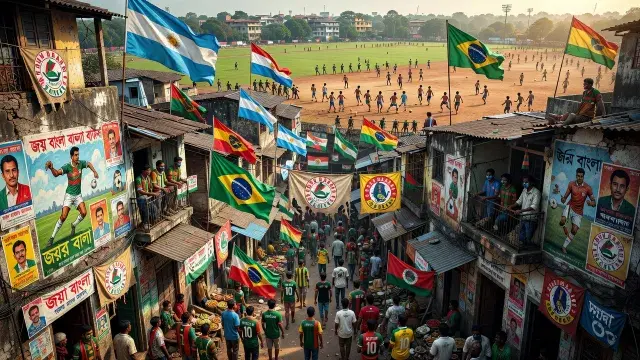
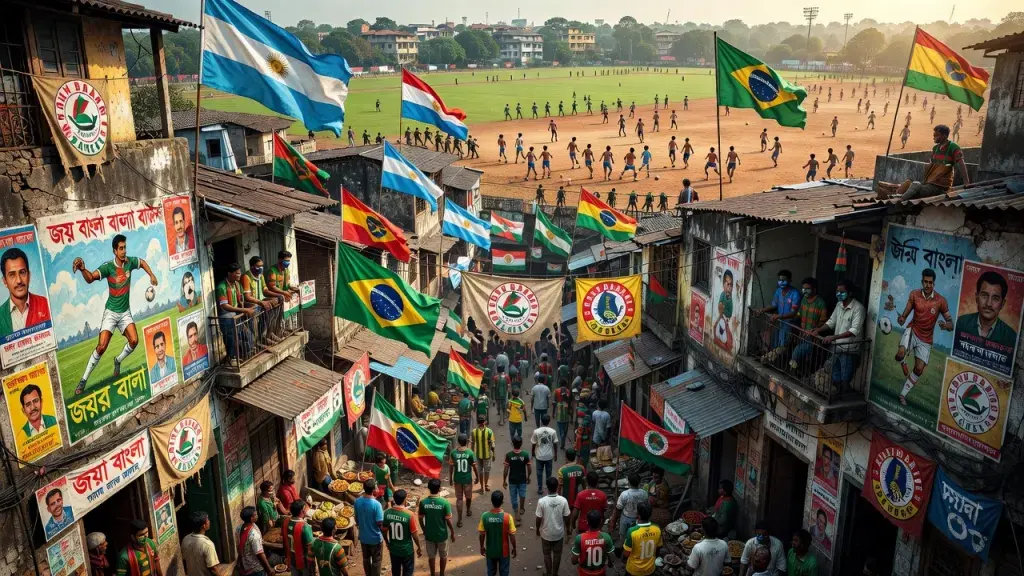
In Kolkata's old neighbourhoods, only two events are considered important enough to plaster across crumbling walls and drape across narrow lanes: a general election and the FIFA World Cup. Every four years, the city decks itself in blue and white for Argentina or green and yellow for Brazil, and the great Latin American rivalry plays out in the paras - the Bengali word for neighbourhoods - of a country that has never once qualified for the tournament being celebrated. It is, depending on your perspective, either the most romantic thing about Indian football or the most damning indictment of it.
The passion that ignites Kolkata during a World Cup has no obvious parallel in world football. Cities from Rio de Janeiro to Lagos to Mumbai have their football obsessives, and across the globe there are supporters for whom the game is a kind of secular religion - much like the devotion some attach to a rapido russia draw, that peculiar thrill of waiting on an outcome entirely beyond your control. But Kolkata is something else entirely: a city with no horse in the race, no compatriot on the pitch, no realistic hope of qualification, yet one that mourns Messi's defeats and celebrates Neymar's goals with a grief and joy that are utterly genuine. The city has earned the unofficial title of the 'Mecca of Indian Football', and the history behind that title is one of the most remarkable stories in the sport's global spread.
From the Maidan to a Symbol of Resistance
Football arrived in Kolkata - then Calcutta - in the 1850s, carried by British soldiers and civil servants who turned the Maidan, the vast open green at the city's heart, into their playing ground. What happened next was neither planned nor inevitable: the game took root with extraordinary speed among a population the colonisers had not intended to include. Bengali middle-class men, mill workers from Bihar and Odisha, migrants and refugees from East Bengal - all found in football a common language that needed no translation.
By the 1880s, Indian clubs were forming and, crucially, winning. Mohun Bagan AC - now Mohun Bagan Super Giant - was established in 1889. Mohammedan Sporting Club followed in 1891, and East Bengal FC was founded in 1920. The defining moment came on 29 July 1911, when Mohun Bagan defeated the East Yorkshire Regiment in the IFA Shield final, becoming the first Indian side to win the tournament. Barefoot players - some accounts from the time made specific note of this - had beaten the army of the empire on the empire's own turf. It was no longer merely a sporting result. It became a political statement, a proof of equality administered through football, and it embedded the sport permanently into Kolkata's identity.
Passion Without Infrastructure: India's Enduring Contradiction
The paradox of Indian football is not a shortage of love for the game. It is the failure to convert that love into competitive infrastructure. Today, the most football-obsessed regions of India are not its great cities but its Northeastern states: Manipur, Mizoram, Meghalaya, Nagaland, and Sikkim have produced the majority of the country's finest players. In these communities, football occupies the cultural space that cricket claims almost everywhere else in the subcontinent. Local leagues and neighbourhood tournaments are not recreational afterthoughts - they are central to social life.
Yet none of this passion has produced sustained results on the global stage, and the reasons are structural. Countries that qualify consistently for the FIFA World Cup invest heavily in youth academies, organised scouting networks, professional coaching pathways, and sports science. India's football ecosystem, by contrast, remains fragmented. Many talented players grow up without access to quality coaching or professional facilities, and no clear pathway into elite football exists at scale. The Indian Super League has brought professionalism and visibility to the sport's top tier, but the investment has remained concentrated there rather than filtering down to grassroots development. Football administration in India has historically suffered from bureaucratic inefficiency and inconsistent planning - problems that have cost the country decades of potential progress. The dominance of cricket, supercharged since India's 1983 World Cup win under Kapil Dev and turbocharged by the commercial revolution of the 1990s, has ensured that football receives a disproportionately small share of media attention, sponsorship, and institutional support.
The Blue Tigresses and a Glimpse of What Could Be
The brightest chapter in contemporary Indian football is being written not by the men's game, but by the women's national team. Once suspended by FIFA for more than 18 months in 2009, the Blue Tigresses have rebuilt steadily and dramatically. In July 2025, they qualified for the AFC Women's Asian Cup for the first time - a milestone that would have seemed implausible to anyone who tracked the team's nadir a decade and a half ago. In the qualifying campaign for the 2026 edition of the tournament, India defeated Thailand 3-1, with midfielder Sangita Basfore scoring twice. Young players including Hemam Shilky Devi, Jyoti Chauhan, and Naorem Priyangka Devi are driving the team's ascent, and while India's current FIFA women's ranking of 70th reflects how much ground remains to be covered, the trajectory is unmistakably upward.
The irony is not lost on anyone watching closely: Kolkata, which sends thousands of boys and girls onto Maidan pitches every morning in a tradition stretching back more than 150 years, is also the city whose two greatest clubs - Mohun Bagan and East Bengal - spent the opening months of 2026 in genuine uncertainty about whether their season would take place at all, caught in a dispute between a federation and a broadcaster that had nothing to do with football quality and everything to do with money and governance. The game's administrators have repeatedly failed the very culture that sustains them.
India's problem has never been a shortage of passion or talent. From the Kolkata Derby - one of Asian football's oldest and most emotionally charged fixtures, carrying within it the histories of Partition and displacement - to the football grounds of Imphal and Aizawl, the sport holds a place in India's national imagination that no statistic can adequately capture. The challenge now is not to generate enthusiasm. The country has that in abundance, plastered across crumbling walls every four years for a tournament it cannot enter. The challenge is to build the institutions and infrastructure that could one day change that.