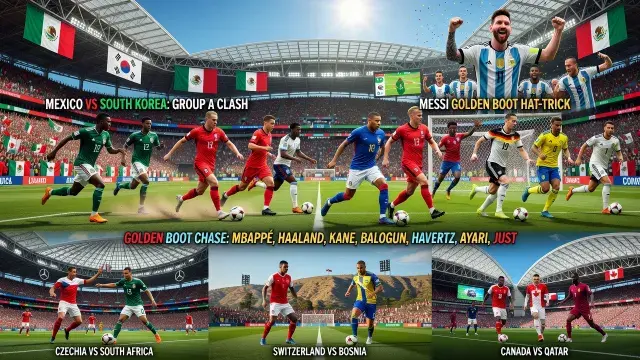
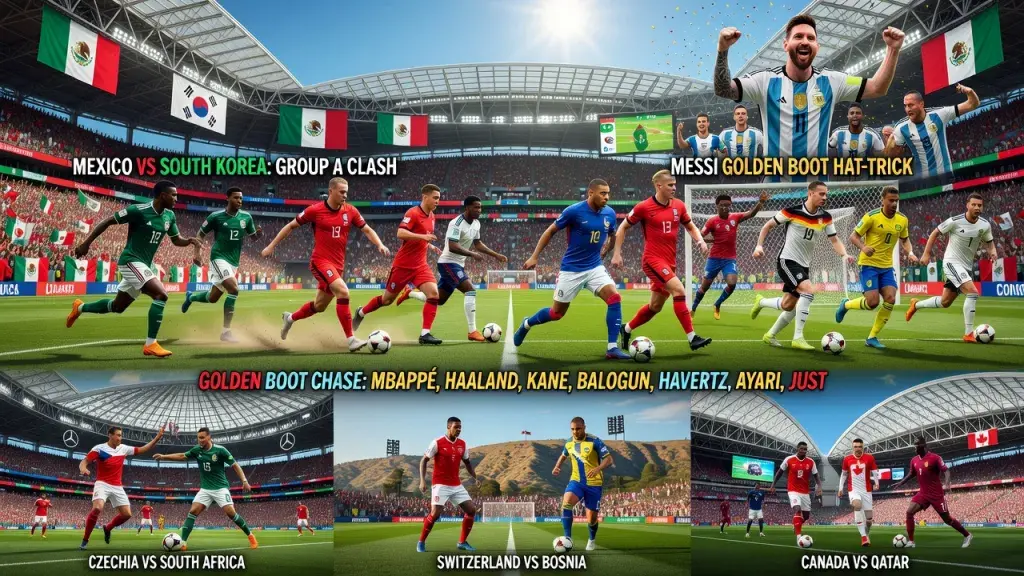
Thursday brings another full slate of group-stage football to the 2026 World Cup, headlined by a potentially decisive Group A encounter between Mexico and South Korea in Guadalajara. Both sides arrive having won their opening matches, meaning the winner will move to the top of the group in excellent shape to secure a place in the knockout rounds. Elsewhere, Czechia, Switzerland and Canada are all expected to assert themselves against their respective opponents, though the tournament has already shown that nothing at this stage should be taken for granted.
The wider picture beyond Thursday's fixtures is equally compelling. The Golden Boot race is already fiercely contested, Africa is generating some of the tournament's most memorable stories, and debates about hydration breaks and the game's cultural diversity are running alongside the action on the pitch. Much like the growing global appetite for sport across different formats and markets - from football to netball online betting - the tournament is connecting fans around the world in ways that extend well beyond the ninety minutes. netball online betting
Thursday's Schedule and What's at Stake
The day opens at noon local time in Atlanta, where Czechia face South Africa in what looks a tricky assignment for both sides. South Africa's Bafana Bafana enter having lost their opener to Mexico but carry a respectable record against European opposition at World Cups, including a memorable 2-1 victory over France in 2010. Czechia, who lost 2-0 to Ghana in their only previous World Cup match against African opposition, are favoured but cannot afford complacency. Opta's simulations give Czechia a 54.9 percent chance of victory against 21.8 percent for South Africa.
At noon in Los Angeles, Switzerland take on Bosnia and Herzegovina in their first-ever World Cup meeting. The two nations met once before in a 2016 friendly, with Bosnia winning 2-0 through goals from Edin Dzeko and Miralem Pjanic. That result is unlikely to count for much now: Switzerland are clear favourites, winning 61.6 percent of Opta's pre-match simulations, with Bosnia prevailing in just 17 percent.
Canada host Qatar in Vancouver at 3pm local time in a fixture where history strongly favours the home side. On each of the three previous occasions a World Cup host nation has faced an Asian opponent at the tournament - Mexico vs Iraq in 1986, France vs Saudi Arabia in 1998, and Russia vs Saudi Arabia in 2018 - the host has won. Opta's model gives Canada a 72.9 percent chance of continuing that run, with Qatar's probability of causing an upset sitting at just 10.6 percent.
The evening's marquee fixture is Mexico versus South Korea, kicking off at 7pm in Guadalajara. El Tri have won both of their previous World Cup encounters with the Koreans, including a 2-1 victory at Russia 2018. With Opta giving Mexico a 49.1 percent chance of winning across 25,000 simulations - against 24.3 percent for South Korea and 26.6 percent for a draw - the Mexicans start as favourites on home soil, though a South Korean side that opened with a win will not arrive without belief.
Golden Boot Race, History-Makers and the Big Talking Points
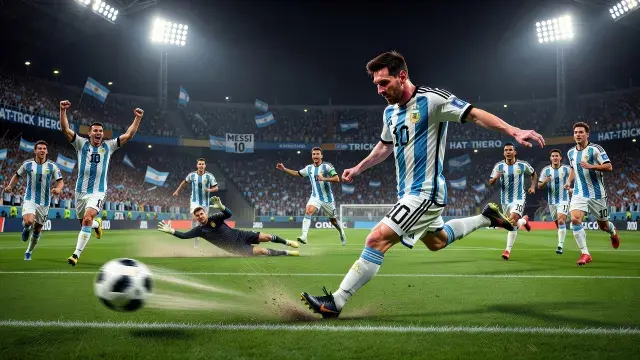
Lionel Messi leads the Golden Boot standings with three goals after a hat-trick in Argentina's opening win over Algeria, putting him already ahead of a chasing pack. Seven players share second place on two goals apiece: Kylian Mbappé, Erling Haaland, Folarin Balogun, Kai Havertz, Yasin Ayari, Elijah Just and Harry Kane. With Messi and Ronaldo both present at a sixth World Cup - an achievement no other player in history has matched - the tournament is already delivering its share of landmark moments, though Cristiano Ronaldo's opening match ended in frustration: the 41-year-old missed several chances as Portugal were held 1-1 by DR Congo.
That result was historic for the Leopards. Yoane Wissa's headed goal shortly after half-time made him the scorer of DRC's first-ever World Cup goal, 52 years after the country - then known as Zaire - last appeared at the tournament. It was one of the competition's standout moments from the opening round, alongside Cape Verde's 0-0 draw with Spain, which the Blue Sharks earned on their World Cup debut. Colombia, meanwhile, beat debutants Uzbekistan 3-1 in Mexico City, with Luis Díaz instrumental throughout.
Africa's Record Presence and the Issues Beyond the Pitch
A record six sub-Saharan African nations are competing at this World Cup, and their collective story is one of the tournament's defining threads. South Africa were first to take the field, losing the opener to Mexico. But the continent's representation is broader and deeper than at any previous edition: Senegal, Ivory Coast, Ghana, DR Congo and Cape Verde all feature, carrying the weight of expectation from a vast diaspora - estimated at more than three million people across the US and Canada alone.
The road to the tournament was not without difficulty. Many fans with African passports faced significant bureaucratic hurdles, including a requirement to post $15,000 bonds to enter the United States - a policy that was eventually dropped but not before it had effectively shut some supporters out of the planning process. The vuvuzela, which became a global symbol of the 2010 World Cup in South Africa, has been banned at this year's event, removing one of the more visceral connections between the tournament and the continent's football culture.
FIFA's new hydration breaks are also generating friction. Introduced to manage the physical demands of playing in summer heat across three host countries, the stoppages have been criticised by pundits including Alan Shearer and Roy Keane, who argue they disrupt the rhythm of matches and hand coaches unscheduled tactical windows. The debate sharpened after Curaçao scored against Germany before a break in Houston, only to concede twice before half-time in an eventual 7-1 defeat. FIFA maintains the breaks are a player welfare measure; critics contend they also benefit broadcasters through additional advertising time.
On and off the pitch, the 2026 World Cup is shaping up to be one of the most layered tournaments in recent memory - rich in sporting drama, historic firsts and unresolved questions that will run well beyond Thursday's four fixtures.